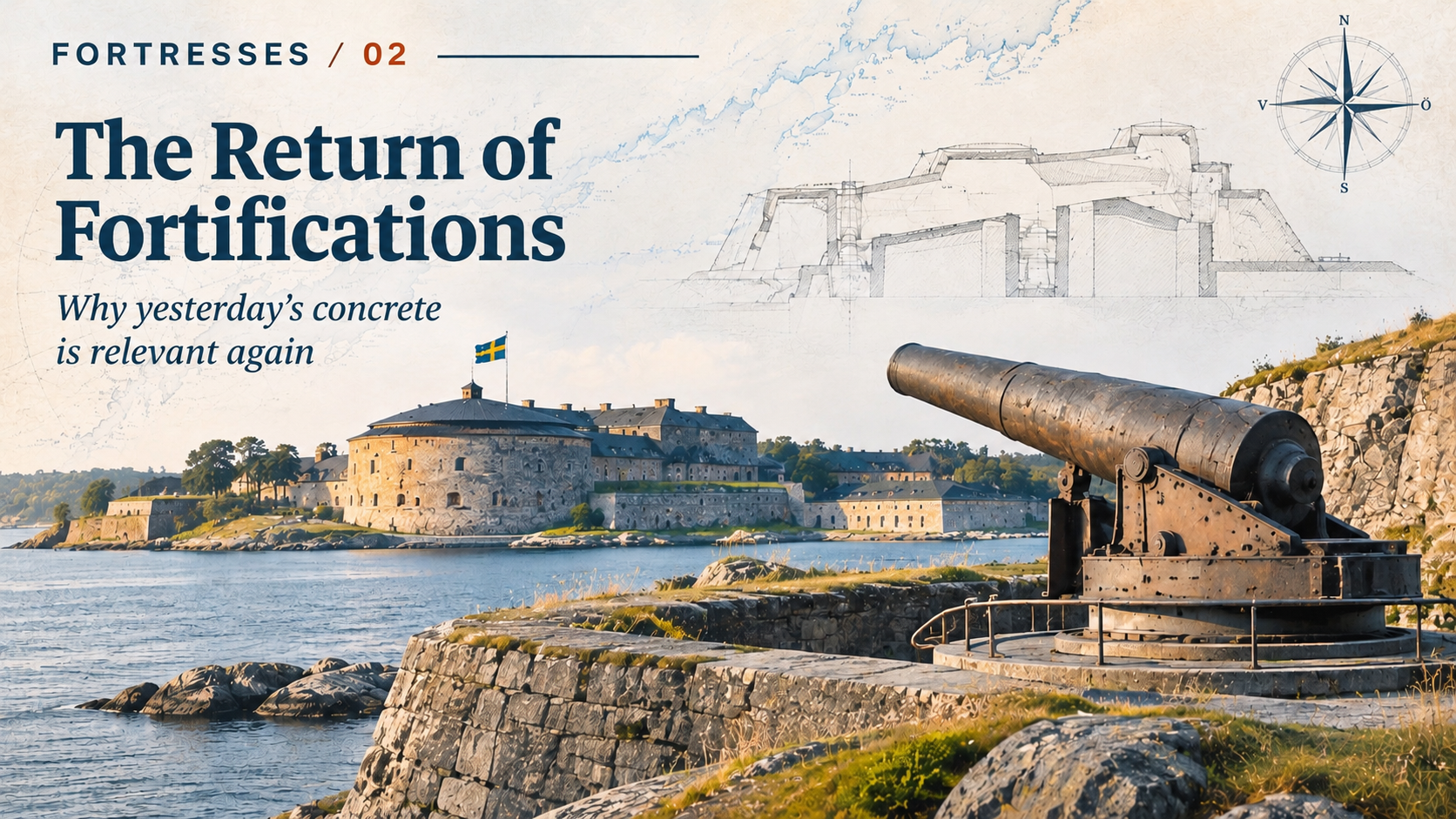
A short tour of strategic ambition, stubborn masonry and changing technology
FORTRESSES / 02 | Personal essay series | November 2026
An expensive way to learn that history moves
Sweden has an impressive habit of building things intended to last for centuries. The enemy, unfortunately, has never signed up to the same timetable.
In the opening article, David Betz’s Fortification and Strategy sent me back through old books, family history and a rather long list of fortresses I have visited. This time I want to look more closely at what Sweden actually built—and what those investments achieved. Not a ranking of our most expensive mistakes: that would require a considerably better spreadsheet and several centuries of disputed assumptions.
A fortress is not simply a wall with a gun attached. It is a promise about geography, technology, political purpose and the time available to react. Some of those promises age remarkably well. Others expire while the builders are still arguing over the gate.
Before the great fortresses: governing from behind walls
I visited Åbo Castle in Turku with the children, and what stayed with me was its extraordinary ability to change shape and purpose without disappearing from history. Begun in the 1280s as a fortress controlling the Aura River approaches, it evolved into a royal residence, administrative centre, prison, storehouse and eventually a museum. It did not escape destruction entirely: Soviet bombing badly damaged the castle in 1941. But the post-war restoration preserved and reconstructed much of what had survived. It is a particularly good example of a building outliving not only its weapons, but several of the political systems that once occupied it.
The interesting question is therefore not whether a medieval castle remained militarily relevant forever. Of course it did not. It is how many times its owners found another useful purpose for the same structure. Sometimes the best defence against obsolescence is a change of job description.
Sveaborg: the fortress that survived its own strategic defeat
Construction of Sveaborg—today Suomenlinna—began in 1748, when Finland was part of Sweden. It was a monumental attempt to defend the eastern half of the kingdom and support naval operations in the Baltic. But the surviving fortress is not a frozen Swedish design. Swedish, Russian and Finnish authorities repeatedly adapted its structures and military functions. What we see today is the accumulated result of several centuries of changing requirements.
In 1808, Sveaborg surrendered to Russian forces. The circumstances, the commander’s decisions and the wider political and military context have been debated ever since. Calling it a case of impregnable walls defeated by treachery is a tempting story. It is also a very poor substitute for history.
Here is where Sweden’s traditional takeaway from 1808 deserves a more uncomfortable question. The surrender was a Swedish strategic disaster, but was the fortress itself therefore a mistake? Russia continued using and modifying it after the conquest. Its defences were adapted during the nineteenth century; during the First World War it formed part of the wider maritime defence of St Petersburg; and in the Second World War the Finnish fortress supported coastal artillery, anti-aircraft defence and submarines. The major military role declined after 1944, with the coastal artillery regiment leaving in 1972 and civilian administration beginning in 1973. A fortress that served three states and remained militarily useful into the twentieth century is a poor candidate for a simple verdict of technical failure. The more revealing question is why Sweden lost it in 1808.
There is also a family connection that makes this history less abstract for me. My ancestor Georg Samuel von Gegerfelt served in the Swedish navy during Gustav III’s war against Russia, including the Battle of Hogland in 1788 and the breakout from Viborg Bay in 1790. The Swedish sailing fleet used Sveaborg during the 1788 campaign, although I have not established that he personally stayed there. An attractive family anecdote is not a naval logbook.
A detail worth distinguishing: the Swedish archipelago fleet wintered at Sveaborg in 1788–89, whereas the sailing fleet returned to Karlskrona before winter. Mixing up those fleets is an easy way to turn a plausible story into an inaccurate one.
Karlskrona: what the walls were really protecting
Karlskrona, founded in 1680, offers almost the opposite lesson. Its enduring value was never just a set of coastal batteries. It was a purpose-built naval system: sheltered basins, dockyards, workshops, stores, administration, skilled workers and the means to keep a fleet operating.
This is perhaps the clearest Swedish reinforcement of Betz’s argument that fortifications must be understood in relation to the forces and functions they support. The point was not to preserve masonry for its own sake. It was to preserve the navy’s ability to operate.
UNESCO recognises Karlskrona as an exceptionally well-preserved example of a planned European naval city. That recognition is cultural rather than a verdict on every military decision made there. Still, the survival of the wider naval and industrial ecosystem is a powerful reminder that adaptable infrastructure can outlive the weapons it was designed to serve.
Vaxholm: Sweden’s most expensive woodshed?
At Vaxholm, technology seems to have developed an unfortunate sense of timing. The present castellated fortress was built between 1833 and 1863. Advances in artillery meant that its masonry protection was already inadequate when the project was completed. Subsequent firing trials made the problem painfully clear.
The National Heritage Board records a rather magnificent insult: critics called it “Sveriges dyraste vedbod”—Sweden’s most expensive woodshed—after its military role was reduced largely to storage.
It is a memorable phrase, and precisely the sort of historical nugget that deserves to survive in an article. But it is not a complete cost-benefit assessment. The narrow passage it was built to protect could be obstructed, and the principal shipping route was redirected through Oxdjupet, where Oscar-Fredriksborg offered a different defensive solution.
The broader lesson is about adaptation. The problem was not that the Swedish engineers had forgotten how to build. It was that improved artillery changed what counted as protection. The next generation moved toward lower profiles, rock and concrete. Even the geography of the defended approach changed.
Karlsborg: a ten-year plan with a ninety-year delivery
After the loss of Finland in 1809, Swedish planners faced a grim geographical reality: Stockholm had become more exposed. One answer was central defence, with a secure reserve capital deep inland. Karlsborg, on Lake Vättern, was intended to shelter the monarchy, government, national valuables and essential functions if the coastal defence failed.
Construction began in 1819. The initial expectation was roughly a decade. The full project continued until 1909. Ninety years is an impressive period of institutional commitment. It is less impressive as a response time to an evolving threat.
One delightful detail from Statens fastighetsverk: the original concept envisaged three inland fortresses, but only Karlsborg was built. Another: its monumental final defensive barracks is 678 metres long and included a church intended to accommodate parliament in wartime. Sweden had planned not only where to retreat, but where to continue legislating.
The central-defence concept eventually lost relevance as transport, weapons and military doctrine changed. Yet Karlsborg did not vanish: it remains an active military and civilian environment. Again, the original strategic concept and the subsequent value of the infrastructure must be judged separately.
There is a further human dimension worth remembering. Much of the early construction was hard manual labour performed by a mixture of workers and prisoners. A ninety-year programme is not merely a line on a capital budget; it consumes lives, skills and opportunities across generations.
Boden and Siarö: the next era arrives early
By the beginning of the twentieth century, the centre of gravity had shifted north. Boden’s ring of rock forts protected a strategic railway and communications hub, with accommodation, power, water and other functions designed for prolonged isolation. The engineering logic was changing from thick walls to protected endurance.
Siaröfortet, guarding the Furusund approach to Stockholm, shows the other side of that transition. Work began in 1916, stopped half-finished at the end of the First World War, resumed in 1921, and was completed in 1924. It was first manned in 1926. Discussions about moving the defence farther out had already begun in 1920; its original role ended in 1939.
That chronology is almost unfair to the builders. They delivered an ingenious concealed installation, just as the strategic geography was shifting beneath it. I have visited Siarö, and its interior makes another point that rarely appears in the heroic photographs: being protected underground and being comfortable enough to function there for long periods are different engineering problems.
Siarö and Boden are our bridge to the next article. By now the Swedish fortress was becoming less of a castle and more of a protected operating system—often hidden inside the rock.
So which were mistakes?
There is no honest one-word answer. Vaxholm’s masonry was overtaken by artillery. Karlsborg’s original concept aged during construction. Sveaborg surrendered in 1808, yet continued to be adapted for Russian and Finnish military purposes into the Second World War. Åbo Castle was damaged, restored and repeatedly repurposed. Karlskrona demonstrates the value of an integrated naval system. The outcome of one campaign and the lifetime value of an installation are not necessarily the same thing.
A fortress that never fought cannot automatically claim success through deterrence; proving that counterfactual is difficult. But neither does an absence of battle make it a failure. A sensible assessment asks what function it protected, for how long, at what total cost, and what else might have been achieved with the same resources.
Perhaps that is the real disagreement with a simplistic reading of the return of fortification: the challenge is not to build stronger things. It is to build things whose protected purpose can survive a change in weapons, geography or politics.
Next, we go underground. Sweden became remarkably good at hiding military capabilities in rock. The more awkward question is what happened when we decided we no longer needed much of it.
Questions worth arguing about
Which Swedish fortress was a genuine strategic mistake—and which has merely been judged against the wrong objective?
Would we evaluate Karlskrona, Sveaborg or Karlsborg differently if we measured the value of protected functions rather than the survival of their original weapons?
And when today’s defence planners invest in permanent infrastructure, who is responsible for asking whether the underlying assumptions will still hold when it is ready?
Sources and further reading
Turku Castle — Built from Ruins. Museum account of the 1941 bombing and post-war reconstruction, 1946–1961. https://turunlinna.fi/en/exhibition/built-from-ruins/
Suomenlinna Governing Body — History of the Fortress and Management Plan 2020–2024. Swedish, Russian and Finnish modifications; First World War maritime defence; Second World War coastal artillery, air defence and submarine base; military drawdown in 1972–73. https://suomenlinna.fi/en/explore/history/ and https://suomenlinna.fi/wp-content/uploads/2025/09/Management-Plan-Fortress-of-Suomenlinna-2020-2024_V2.pdf
Riksantikvarieämbetet — Vaxholms kastell. Construction history, artillery obsolescence and the “most expensive woodshed” epithet. https://bebyggelseregistret.raa.se/bbr2/byggnad/visaHistorik.raa?byggnadId=21400000355479&page=historik&visaHistorik=true
Statens fastighetsverk — Karlsborgs fästning. The reserve-capital concept, construction chronology and continuing use. https://www.sfv.se/vara-fastigheter/sverige/vastra-gotalands-lan/karlsborgs-fastning
Ulf Sundberg, Swedish Defensive Fortress Warfare in the Great Northern War 1702–1710 (2018). For readers interested in the operational limitations of Sweden’s Baltic fortress system; not used here to establish individual nineteenth-century construction dates.
Nils Ahlberg, Town Planning and Urban Fortification in Sweden, 1521–1721 (2005). A deeper study of how fortifications, towns and state power developed together.
Försvaret av Stockholm — background reading on Stockholm’s maritime defence. https://fokk.eu/tryck/36%20Fo%CC%88rsvaret%20av%20Stockholm.pdf
Personal visits and family recollections. Narrative motivation, not independent evidence for disputed historical claims.
Read the complete Fortresses series
Each article stands on its own; together they follow how the purpose of fortification has changed—and what has not.
01 — How a Few Fortresses Became an Obsession
Swedish fortresses, magnificent mistakes, and the uncomfortable return of an old military idea
How David Betz’s essays turned one historical curiosity into a personal journey through Swedish fortifications and the questions they raise.
02 — Sweden’s Magnificent Fortresses — and Some Magnificent Mistakes
A short tour of strategic ambition, stubborn masonry and changing technology
From Sveaborg and Karlskrona to Vaxholm, Rindö, Siarö and Boden: impressive engineering, changing threats and the difference between failure and lasting value.
03 — The Country That Built Underground
A personal exploration of Swedish protection, ingenuity and uncomfortable economics
Cold War Sweden beneath the surface: coastal batteries, command centres, civil-defence facilities, ERSTA and the extraordinary cost of keeping people and capabilities protected.
04 — The Country That Walked Away
The difference between retiring a weapon and forgetting how to protect a country
What Sweden dismantled, what Finland retained, and why the fate of shelters, reserves, specialist knowledge and protected infrastructure still matters.
05 — The Fortress Returns — But Perhaps Not as We Remember It
From Narva and NATO to hospitals, logistics and the decidedly unromantic business of keeping a country functioning
Sweden’s enlarged NATO defence map meets lessons from Ukraine: which physical facilities should be hardened, dispersed, rebuilt or simply made recoverable?
06 — The Fortress Without Walls
A connected defence in depth — and why concrete has not had its last word
A layered defence of sensors, mobility, interceptors, redundancy, drone nets and selective hardening—testing whether a network can deliver the strategic effects of a fortress.
I appreciate if you want to leave a comment on this post