Really good article about how the notion of a camera is changing with AI. I also appreciate that the privacy perspective is well covered. What I especially appreciate how the journalist Doug Chayka takes us from the futuristic perspective to actually testing two AI enabled cameras with the learnings we can draw already on today’s use of them.
Review of the Fast Company Top 50 Most Innovative Companies 2018 including the golden nuggets I picked
The Fast Company, a modern type of media brand, with a focus on innovation in technology, leadership, and design. So worth to subscribe to their newsletter. Has just released their top 50 most innovative companies 2018.
I am by nature skeptical towards this types of list as often subjective in how they are created. In the list I am missing both a number of innovative european companies and especially several Asian companies. Still I think their subjective vetting process is acceptable and at least transparent.
I do not know all the companies in the list but the majority I am familiar with for sure belongs to be there even if I find it less important what rating they are given.
It is more interesting to read their rational on why each company is on the list and for myself several new companies picked my interest such as:
Square, a payments company dedicated to serving micro-entrepreneurs and growing small businesses
Tencent’s WeChat messaging app with 980 million active monthly users that is not only a social media platform but also can hail a taxi, look up a restaurant review, make a reservation, and pay for dinner. One of the few Asian companies on the list as well
Reliance Jio, first Indian 4G LTE driving mobile data connection, as another Asian example
AliveCor that developed the first smartphone-connected electrocardiogram where the CEO Vic Gundotra claims “we are an AI company disguised as a medical device company.”
A few listed old companies and organisations gave me a reason to check out what new things they are doing:
The Ford Foundation funds, independent trust founded by the Ford family that has reinvented how to deliver on their mission with such as a team that work with Technology and social justice
Gucci, has gone through a transformation with a focus on social media by collaborating with popular artists and influencers who have styled Gucci products in fresh new ways. On a personal level I realize while reading about them that I recently brought a pair of Gucci jeans for the first time. So much for my perceived independence and integrity of not letting myself be influenced by simple marketing tricks
As a Sweden I am of course proud that Spotify is in the top-tier (#9) and I had a very good timing of my week-end reflection about their AI.
One reflection on this companies if they would qualify for also being labeled Smart Companies? Instinctively I would say probably but there might be a few more criteria than just innovative and growing. That leads us to the question: what is the definition of a Smart Company? To be honest I only have a wage answer now and sounds like a good topic for a future post.
Fast Company is the world’s leading progressive business media brand, with a unique editorial focus on innovation in technology, leadership, and design.
That question is probably not the most common question from a 7-year-old girl. She asked it as she was concerned the AI’s will take over before her next birthday. My 17-year-old kid has also educated her in never publishing a picture where AI face recognition could tag her. Hence as you can see she heavily distort any pictures she publish. So in terms of AI maturity and insights she is more AI mature than many adults.
Is she right to already now ponder on this topic?
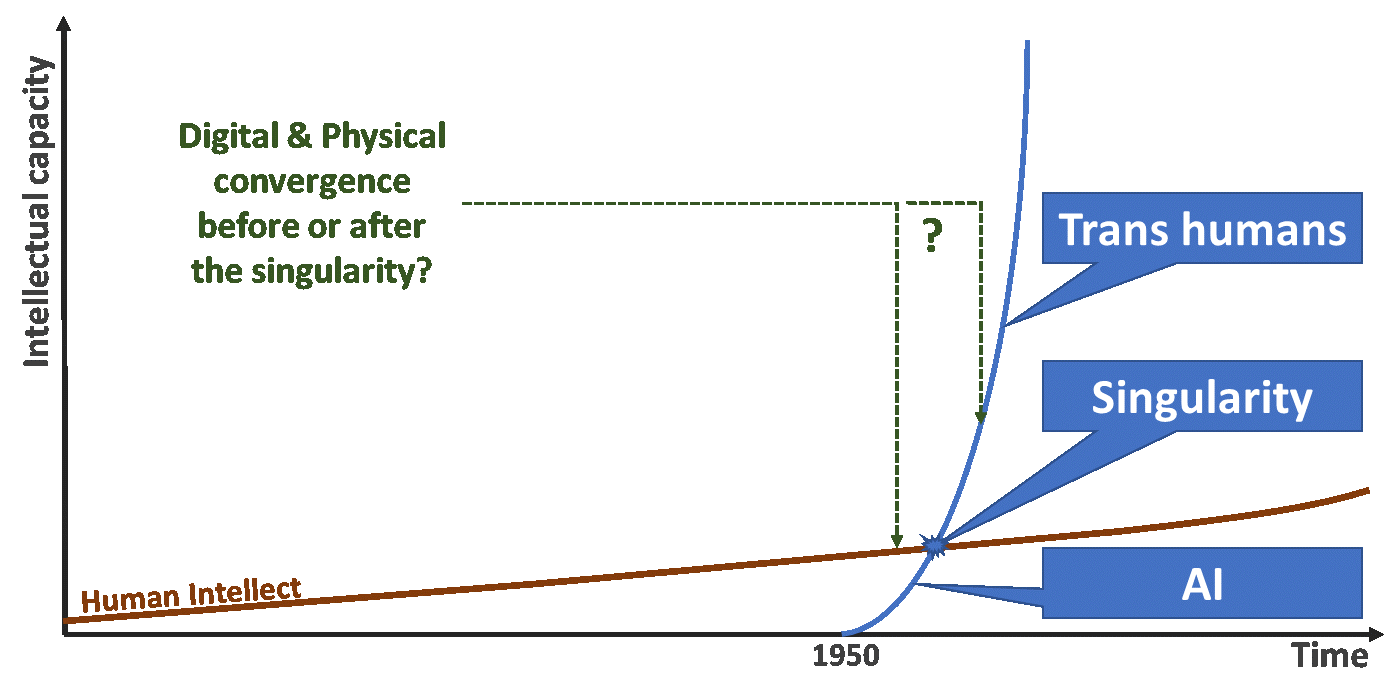
Before answering that let’s get some basics outlined first on what we mean with Technical Singularity and the physical and virtual world convergence.
Technical Singularity
The singularity, ergo that machine can build machines by themselves would not be so concerning if they would run in isolation without connection to the physical world.
This 3 min Tedx talk from Jason Silva is a good introduction to the subject with a non alarmist tone
If you are interested in more depth about Technical Singularity I strongly recommend to read Life 3.0: Being Human in the Age of Artificial Intelligence a book by the Swedish-American cosmologist Max Tegmark from MIT. He is also the co-founder of the Future of Life Institute (great site to visit), and has with donations from Elon Musk investigates the existential risk from advanced artificial intelligence. If you find his 796 pages overwhelming there is a 34 min pod as an alternative.
If you prefer something even easier to digest, the scenario depicted in the books Prelude is similar to the movie Transcendence.
http://www.imdb.com/title/tt2209764/
Physical and virtual world converging or Dual Reality
Interestingly enough the technical Megatrend that the physical and virtual is converging is not at al as well explored and written about as the Technical Singularity. Probably because there is not one big key event that is expected to happen but rather this Megatrend is the sum of many sub-trends and enablement such as:
AI and machine intelligence as covered above
Mixed reality capabilities in the broadest sense where machines are able to stimulate our sense´s generally in a one directional way even with some feed-back loops
Biosyncing / biomedical engineering where human and machine are connected with reciprocal feed-back lops (such as a pace maker)
Neural engineering where we can connect our brain directly with the virtual world for a bi-directional exchange of data
IoT and connected devices where over time most our machines, buildings, cars are connected
IoT smart sensor and actuators where you can collect almost any data from the physical world as well as interacting with it
Edge/Mist/Fog/Grid computing to make sure that there is always enough computing power with minimal latency or bandwidth limitations
The best and simplest overview on the subject I have found is a Australian Consultancy firm called Emergent // Future that has written the paper together with Denis Hurley that is Director Future Technologies at Pearson.
There is a MIT publication from 2009 (not a light reading) that labels the merger “Dual Reality”. I have also picked up others label this “Mixed Reality”. On one hand I like Dual/Mixed Reality because it is a short and snappy label for the trend. On the other hand it still suggest this two worlds are clearly separable, true for the foreseeable future but with the latest Biomedical / Neural Enginering the questions is for how long . nevertheless I really like their proposed definition:
” The convergence of sensor networks and virtual worlds not only as a possible solution to their respective limitations, but also as the beginning of a new creative medium. In such a “dual reality,” both real and virtual worlds are complete unto themselves, but also enhanced by the ability to mutually reflect, influence, and merge by means of sensor/actuator networks deeply embedded in everyday environments.”
– Joshua Lifton and Joseph A. Paradiso, MIT Media Lab
Reflection
No one can tell exactly when this two mutually supporting events will happen where a god guess is that my grand children will see them both during their lifetime
It is when the AI could access all of the current physical realms that things get delicate. Imagine your brain is connected (yes in 2017 a human brain was connected as a IoT device). Lets then assume that a AI can tamper with your brain perception of reality. The singularity in that scenario becomes far more concerning (think Matrix) than for example today where a AI would have a limited access (still big enough to cause lots of concerns) to the physical word.
So what could we learn from a 7 year old child in terms of bothering already today about the upcoming singularity and convergence between the artificial and real world?
From a business perspective if your business is not actively exploring the opportunities of the smart society (broader concept than Digitalization) you are likely working in one of the +40% of companies that will not make the leap to the smart society. As employee in such a company it is time to look for a better place to work. I have already in my investments started to assess what companies I believe will make the leap or not.
From a private perspective I would already today think about all my connected devices and check how secure they actually are and what personal data do they collect. Nowadays I always perform a security check on any connected device and past 2 years suggest my kids toys are the worse among in general poorly designed IoT devices. Even my home alarm system (one of the most frequent in Sweden) wanted to open up a permanent port in my firewall, not a good idea. I received a IoT based water meter where I realized that data would be perfect for a burglar to tap on to figure out if anyone is home, fortunately it had really good security. That water meter is also a very good example of the benefits with connected devices as my water company at no additional cost today offers leakage warnings based on AI monitoring my consumption, that feels good as I have had leakages in the past.
My last advice is that your wearable are among the worst in terms of collecting private data. I assume no one missed the connected sex toys (several cases) that where collecting way more data than anyone would imagine, not fun when the hackers get hold of that type of information. At the same time my connected fitness watch has prompted me twice while writing this text I needed to take a break and that is great for my health.
May the force be with you
/FvG
PS: If you have read this far I would really appreciate if you drop a line on your spontaneous thoughts and reflections, I would find that motivating and enriching.
I would actually had missed this whole observation and hence post if a collegue of mine would not had made a good post that we often look too far in the future instead of focusing on the here and now. He suggested we should start create the Smart Society for example by just making our office Smarter as a start. This whole thought of his sparkled my mind while out walking and realizing the album Spotify had just proposed was the perfect soundtrack for when the Digital and Physical converges.
The album is with my musical taste the perfect blend of acoustic and electronic instruments and hence is the musical representation and soundtrack for the convergence
The whole thing also made me realize that the Spotify despite my mix of many allas narrow musical preferences very driven by my listening mood nowadays with four very different Daily Mix most of the time makes a good jobb. That also includes in most of the mixes to avoid overly lyrically driven songs even if I do not only listen to instrumental material as well as my inclination to discover new music. Still a couple of times per month it will throw me something I really do not like but it is definitely worth the hassle for all the good new music it helps me discover.
Spotify Algoritms and I go way back
Up until two years ago the Spotify algoritms and myself where not the best of palls. My music taste as described above made any deep learning algoritm fail and would mix song that for me fits to different moods. I know my friends over at Spotify has made a lot of effort the adress that and for me it know works most of the time.
On the other hand the progress is not only to the merit of the Spotify team. I have since the start of their radio stations I think back in 2012 spent many hours or swiping away songs I did not enjoy and I would expect there is a waste library of what I have liked and not to data mine.
AI learning from this story?
Well actually more than it could appear so let me summarize it in 3 observations
Developing good AI requires time and effort in a persistent continuous improvement mindset. Just consider the time, resources and computing power for the Alfa Go team to make a AI play a boardgame.
For the final tuning you need human interaction to help the AI when it has not done a good jobb. Just like in my Spotify story where even if the AI has analyzed thousand of my listening hours from many years of consumption of the service it still needs intervention from my side to guide it.
AI will in the short future be consumed by us a individual and companies through existing platform providers. They are the one to have the user scenarios where to apply AI, they have the user base to justify the investment and they have the large amount of data needed to feed the AI with
Sadly I think many companies are now engaging into the AI domain not being clear on the above observations and hence are quite likely to fail. But hey, we could assume that is just part of the AI hype cycle
Or is AI a new type of production factor in the economy?
According to Accenture research we should start to see AI as a new production factor and they have 3 main arguments:
AI is neither labor or capital but rather a hybrid between both and as automation is self improving it should not be written off as ordinary automation equipment
AI complement and increases the skills and ability of existing workforce and capital rather than being in competition with them
AI drives innovation mainly by creating new business models based on new use of existing data
By applying the new model on a dozen developed countries and comparing a non AI baseline with a AI a few countries come out as AI mature/ready/forefront (US, Finland, Sweden, UK, Netherlands) where AI stands for significant part of the growth already today and could achieve double digit growth of maximizing AI opportunity
I share the authors view that today’s way of measuring growth has flaws and that we need to find better ways to capture several disruptive technologies do that in the future.
I think there are some benefits with the proposed model thinking about AI as something that will significantly change society over time.
Until we achieve the singularity of AI being able to build new AI I think AI will need to operate together with other technological devices (self driving cars for example) and humans. This means the old combination of human and capital works as a decent approximation even if not perfect.
I would also challenge that AI would not have to be written off over time. An AI that is not maintained, enhanced, given more computing power will decay over time as it would be replaced by better AIs. The AI also drives operational cost even if run in the cloud so there would always be a trade off between that and solving the task by other means.
With current technology maturity I think AI short term is more about replacing white collars as automation did with blue collar in the past. Many task will be automated or significantly transformed while new (train the AI for example) will be created for the white collars.
More interesting is where AI more mid term can enable a smarter society and new business models we will start to change society for real. My belief is that AI likely is a key enabler in that change but will not be sufficient in itself. It is only when you combine the AI with sensor data, robots, better integration with humans, 3D printing and a long list of other technologies and trends that will give us the big changes.
How to measure that change is still out for grabs and the proposed model by Accenture research is probably not the answer even if a good attempt.



You must be logged in to post a comment.