Tag: Smart Company

  • How to get started with Architecture for the Smart Company

    How to get started with Architecture for the Smart Company

    In this paper, that will take 15 min of your life, you will learn:

    1 – Why Smart Companies needs a strong and future oriented Business and Enterprise architecture capability

    2 – What Business and Enterprise architecture is all about in a Smart Company and why that makes me exited

    3 – My top 5 advice based upon my sometimes hard gained experiences

    4 – Why you should avoid the pitfalls of architectural frameworks

    1 – Why successful companies needs a strong Business and Enterprise architecture capability

    When capability gap in the Business and Enterprise domain little will happen in the short-term but over time business models, process and tool landscape will no longer appeal to customers, scale poorly nor be future prof and hence hampering business opportunities and driving up the operational cost.

    In my experience,  architecture is only discussed at CxO level when significant pressure and change arise (such as: Chapter 11, Turnaround, M&A, regulatory changes, market shifts, sky rocketing IT operational cost) but you are then typically in a hurry and thus not always able to do the proper homework with the ideal team.

    In the Smart Company you have a proactive Business and Enterprise architecture capability that reduces the risk for all the above situation happening. As business models and technology also evolve in an increasing pace what was a good architecture yesterday might be undesired legacy tomorrow.

    Please note that we need to separate the need of Business Architecture and Enterprise architecture capability from the decision of having an organizational unit with that name. I have seen some sales and business development organisation that drives great Business Architecture even if not a single employee with that title or certificates in fancy architectural frameworks.

    (*) Capability = A set of people, process, tools and leadership that can deliver a specific function

    2 – What Business and Enterprise architecture is all about in a Smart Company and why that makes me exited

    The purpose and the why is the starting point of the architecture

    There are loads written on this subject so I do not want to repeat that but still this is really the key responsibility of the architecture function to drive, why not jointly with for example HR as a part of the work is to engage all the company. If you want to read more here are a two good links

    – The 5 min readers digest from Smart company – Why Purpose-Driven Companies Are Often More Successful

    – The Guru in the domain is Simon Sinek with 4 millions views of his ted talk –Start with the why

    I get really exited when there is a clear Why to define and work towards. It becomes especially important when you strive towards self orchestrating teams as key for all to have the same common goal and vision.

    It is all about speed and agility

    If you can not make it fast do not bother. If you are afraid to fail do not bother. If you are not able to work hypothesis driven without all answers sorted out do not bother.  Many EA practice miserably fail to deliver what the company needs and some of the failure is due to that they are to procedural (“this is the structured process we work after”) and too slow (“if we do not have time to do it properly we will not engage and do it at all)

    Do not overcomplicated things, any Lean or Agile type of mindset and attitude will do the work. The fact that the team is working together to create their own framework based on the business needs and organizational maturity are worth more than any fancy framework.

    Define where you key pain point are in a back log, asses what information you are missing to make the right call and then as lean as possible gather the data you need to move forward.

    One of the best EA architects I have the pleasure to work with has an even more simplistic approach also to the biggest corporate challenges. He will just drive to clearly define what is the critical and urgent issues to solve . with the help of Kanban board he then drills down were needed to get more information and defines any needed hypothesis needed to be validated in order to solve the problem statement.

    Technology mastery is essential

    If you search for “Technology driven business” you will se that all major strategy and management consultancies will have this in their white papers.

    One of the earliest on this subject is Clayton Christensen, professor at Harvard Business School, that predicted this change already back in 2012.

    In short you need to make sure your architectural practice is able to monitor mega trends, track where different technologies are on the hype cycle, initiate pilots, build competence and scale when technology is mature enough.

    Release the organisations innovation and collaboration potential

    Innovation does not happen by itself. You need to build the capability. The methods that fits R&D might not work for the Business or Enterprise architecture. The importance is to define the needed innovation and from there define the best method, approach and resources where sometime you need more of a one-off and sometimes you want to build more of a continuous stream of innovations.

    An often missed aspect of Agile and Innovation is to foster a culture of curiosity and eagerness to learn

    As part of creating an innovative, open and collaborative culture there is also a need to facilitate collaboration and the establish  self orchestration especially the more decentralized you run the business. Here is also one of the architects key responsibility to systematically collect different teams key concern that is outside their direct control, drive them to conclusion and then make sure all the affected teams are up to speed and implement the latest thinking.

    Another aspect in terms of collaboration is also that as complexity increases and problems become multi dimensional you need to pull in the right multi functional competence to get a long-term prof solution. A positive side effect is also that the decision is already anchored and hence faster gets into execution

    Transformation and constant change is the new normal

    The architectural team needs to also be adept in Business Transformation as great architecture that is not transformed into concrete action has no value. There is a need to work both towards CxO level as well as with the balance of the organization including to measure that change is actually materializing

    One simple but yet powerful method is to ensure there are clear and widely accepted architectural principles and guidelines that self organizing teams can use as support during their problem solving and architectural considerations

    To break silos a simple but powerful way is to ensure shared key information objects and semantic data objects has a shared definition, clear governance,  architectural principle  and aligned tool including that  information is easily accessible and exchanged.

    3 – My top 5 advice based upon my sometimes hard gained experiences

    Photo by Mervyn Chan on Unsplash

    A – Be prepared for that no one loves you or at least that might be the feeling when  you push people or organizations outside their comfort zone into the future. Over time and if you do a good jobb some will start to understand you are one of few that can see around corners.

    B – Pick your team with care as you have to gather a multi functional digital native, innovative, collaborative and agile team to get a critical mass moving forward with haze navigating in the internal political minefields

    C – You need strong leadership backing as you need to cherry pick the team, challenge the organization including CxO level and not be afraid to fail (preferable fast) so when the shit hits the fan somebody needs to back you up

    D – Get the high level sorted out first with Business models, Flows, Processes, Tool landscape, key information object mapped. Ensure it is easy to maintain and shared broadly. The key use is to help communication, understanding and decision-making. Do not map at any detailed level if there is not a clear need for it, but if you do spend the time make it in a systematic and scalable way so other can reuse.

    E – Maximize the use of tools, as long as they are helping. You need tool for Collaboration, Portfolio management, decision-making, Agile delivery management, Automated process discovery/mining and mapping, requirement handling, document digitization. Ideally you also need EA tool even if I am fascinated how poor offerings there is on the market.

    4 – Why you should avoid the pitfalls of architectural frameworks

    This section was originally 4 pages long and I realized it became a paper in itself. In short be careful of all the Architectural Framework and the people advocating them when presented as a one stop shop for all your architectural needs. The often cost much more than the value they deliver and the supporting tools are often even worse in terms of useability.

    Management summary from my not yet  (and perhaps never) published paper

    • If the architects are not seen helping to drive the business forward their role will marginalize, their influence becomes limited.
    • There is no researched evidence, fully in line with my experience, that any of the architectural frameworks (TOGAF, etc) are delivering value, especially outside current legacy when used in full. Of course the framework has loads of toolkits to be used on a need basis
    • The key challenge with the frameworks is that the time to map, document and maintain the collected information greatly exceeds the use when you need to solve a concrete problem. In a fast changing world the level of reuse from earlier documentation has a short life span before it becomes obsolete
    • EA experts has a tendency to spend too much time discussing the framework and methods and not doing value adding architectural work
    • Business and end users are often under represented and/or their input collected by too junior Business Analysts and thus the framework becomes a theoretical model far from the business reality and needs
    • Scale Agile is one of few popular framework I think it is worth to get inspired from but it is still not fully matured for a large enterprise (even if that is their claim). One concrete example is that I miss a clear Business architecture perspective as well as drive unmanageable large need to gather the . I also see the risk it is now growing in size and complexity and thus no longer stay as Agile as intended or to quote: “SAFe® the “Fast Food” of Agile”. To read more here is a good guide on when to use SAFe,  A SAFe Class Review for Agilists / Consultants, and finally a critical view on SAFe.


  • Please vote where you think Digitalization should start in a company

    Please vote where you think Digitalization should start in a company

    What is your view where companies generally should start their Digitalization journey (or as I prefer to label it to transform into a Smart Company).

    Most consultancies will advice Digitalization should start from the top and begin with the customer journey but is that the only truth?

    I am preparing an article on the subject and during the research I noticed there is limited academic material on what is working or not.

    Hence I want your clever input as inspiration so please make your voice heard.

    I have over the years picked up the statements below and you can make both multiple selections (8) as they span different perspectives and you can also add your own statement if needed.

    As always great if you want to post a comment with additional thoughts

    Do subscribe (on the top left) if you want to be sure to get the article based on the poll when published in the short future

  • The Winner takes it all in the Digital Capitalism – Good or Bad?

    The Winner takes it all in the Digital Capitalism – Good or Bad?

    Already in 2009 Digital Capitalism  (Networking the Global Market System – Dan Schiller – MIT Press, 1999) predicted the rise of a few US-based platform companies with scaring accuracy based upon an analysis of a number of structural aspects.

    The book is still very relevant and I thought it was a good start to reflect if Digital Capitalism is helping or not to create a Smarter Society.

     Here is a short version of the books prediction

      • A sys­tem cre­ated by mar­ket forces to serve mar­ket forces can only deepen ex­ist­ing so­cial in­equities and even them out
      • Tra­di­tional net­work (In­ter­net) poli­cies has been gen­er­ally pro­tec­tion­ist, na­tion­al­ist, and so­cially ori­ented
      • Net­work ad­vo­cates ap­plied po­lit­i­cal pres­sure to change pro­tec­tion­ist network poli­cies into neo-liberal poli­cies
      • Net­work re­form began in the United States and moved into de­vel­oped and de­vel­op­ing na­tions
      • Net­work dereg­u­la­tion has re­sulted in neg­a­tive so­cial and wel­fare consequences
      • The In­ter­net deep­ens and widens the reach of cap­i­tal­ism
      • The dig­i­tal cap­i­tal­ist net­work pri­mar­ily ben­e­fits transna­tional cap­i­tal
      • Com­mer­cial net­work de­vel­op­ment has had a neg­a­tive im­pact on the so­cial and wel­fare po­ten­tial of the In­ter­net
      • Com­mer­cial net­work de­vel­op­ment has had a neg­a­tive im­pact on higher ed­u­ca­tion

    How good was the books prediction?

    A good blog with the label:  FAMGA (Facebook, Apple, Microsoft, Google, Amazon) Is Eating The World and The Profound Implications of Five Increasingly Dominant Tech Companies, further deepens on the subject that we are in a “The winner takes it all situation”. So on this subject did Dan Schiller a good prediction.

    With the latest move in the US to potentially twist network neutrality this opens the door even further for the large corporation to make it more difficult for competing start-ups to emerge. So the risk for increased barriers for new digital companies to enter is quite likely. Some good thoughts about this could be read at The future of US net neutrality under Trump. Hence this is another area where Dan Schiller spotted where things where heading.

    All of the big us firms lately are racing to become the center of our home and life (Google Home, Amazons Echo, Apples Homepod, Microsoft’s Cortana, Facebook had M but has recently given up the race) with the ability to continuously monitor what we do and say, that does not feel particular attractive to me as an individual. If you want to read more about the risks Symantec has published a very good paper on the topic.

    The US-based firms are also key players in investing into AI. I have not found any solid source of data on how the spread of AI investments but several sources put the FAMGA in the top 10 of AI investments (US News, Investors.com, Investopedia, Techworld). Where except Baidu a couple of other US-based firms appears such as: IBM, NVIDIA and Netflix.

    So to sum it up there is a clear risk we are going to end up in the dystopian world of many futuristic movies where a few large (and typically evil) corporation rules the world with AI at their disposal. The Winner takes it all is over time not enriching for neither the society nor me as an individual as it only streamlines what we are offered.

    To balance above statement at least some evidence this companies, even if shareholder value are their long-term goal, that they from time to time voluntarily avoid the worst case scenarios. To mention a few concrete ones: Apple is usually trying to respect their users integrity (at least more than the others) and give them many settings on what to share and not, Facebook is lately trying to address filter bubbles and fake media, Google is offering their Google Docs to the use of many organisations and people at limited cost, Amazon is obsessed with Customer satisfaction and do trade of short-term profit. I just hope the sum of that takes us into the green quadrant of the chart below.

    Reflection

    The only thing I think Dan Schiller missed was the rise, partly behind the great Chines firewall, of the Asian digital companies. Cognizant published in 2015 an excellent paper called Asian Rising: Digital Driving with clear facts that Asia is fast becoming the center of digital innovation for the world.

    “The region accounts for half of the world’s total 2.8 billion Internet users, and it is already the largest regional e-commerce market.”

    On the other hand, if you apply his structural approach, you will quickly come to realise that a very similar patterns to the one he discovered for the US-based firms, also is true for the Asian based companies, even if they have their own version of Digital (state controlled) capitalism.

    With a European perspective I see few real challenger in Europe to US-based companies dominance. To be honnest I am not sure it is better for neither me as an individual nor our society to become dominated by Asian based and often governmentally influenced companies as an alternative.

    The question is if there will emerge any counter balancing power, perhaps with some help from EU or local governments, to level the play field? At the same time we need to balance on the thin line between sub optimized protectionism and globalism with fair play. The business Europe, a European business federation are trying to drive the idea of the EU digital single market where EU has started to work on policy making.

    I think the most important thing would be legislation and platforms to give us as people back the ownership of our data and that we over time would start to create platforms where we can control and sell that data.

    So what to do tomorrow to prepare for the future?

    From a business end I would always plan to play ball with the big US-based corporations but try to also seek opportunities with the Asian challengers when you define your digital strategy. You need to at least consider how they could impact your market? As long as the big US companies or Asian challengers has not entered your market unfortunately the Winner takes it all rules in your niche as well. Either you are working at the Winning company or time to look for a job somewhere else.

    From an Individual perspective I am always cautious how much data I share with the US-based companies (or any company actually). And I am waiting until I can run my AI assistant before I’ll start to use them to any larger extent, especially at home. I appreciate all companies that build solution with my integrity in the center and use that as a key selection criteria for what to buy.

    Great if you want to drop a line of what you think or reflect after reading this article, that is quite motivating.


  • Most innovative companies 2018

    Most innovative companies 2018

    Review of the Fast Company Top 50 Most Innovative Companies 2018 including the golden nuggets I picked

    The Fast Company, a modern type of media brand, with a focus on innovation in technology, leadership, and design. So worth to subscribe to their newsletter. Has just released their top 50 most innovative companies 2018.

    I am by nature skeptical towards this types of list as often subjective in how they are created. In the list I am missing both a number of innovative european companies and especially several Asian companies. Still I think their subjective vetting process is acceptable and at least transparent.

    I do not know all the companies in the list but the majority I am familiar with for sure belongs to be there even if I find it less important what rating they are given.

    It is more interesting to read their rational on why each company is on the list and for myself several new companies picked my interest such as:

      • Square, a payments company dedicated to serving micro-entrepreneurs and growing small businesses
      • Tencent’s WeChat messaging app with 980 million active monthly users that is not only a social media platform but also can hail a taxi, look up a restaurant review, make a reservation, and pay for dinner. One of the few Asian companies on the list as well
      • Reliance Jio, first Indian 4G LTE driving mobile data connection, as another Asian example
      • AliveCor that developed the first smartphone-connected electrocardiogram where the CEO Vic Gundotra claims “we are an AI company disguised as a medical device company.”

    A few listed  old companies and organisations gave me a reason to check out what new things they are doing:

      • The Ford Foundation funds, independent trust founded by the Ford family that has reinvented how to deliver on their mission with such as a team that work with Technology and social justice
      • Gucci, has gone through a transformation with a focus on social media by collaborating with popular artists and influencers who have styled Gucci products in fresh new ways. On a personal level I realize while reading about them that I recently brought a pair of Gucci jeans for the first time. So much for my perceived independence and integrity of not letting myself be influenced by simple marketing tricks

    As a Sweden I am of course proud that Spotify is in the top-tier (#9) and I had a very good timing of my week-end reflection about their AI.

    One reflection on this companies if they would qualify for also being labeled Smart Companies? Instinctively I would say probably but there might be a few more criteria than just innovative and growing. That leads us to the question: what is the definition of a Smart Company? To be honest I only have a wage answer now and sounds like a good topic for a future post.

    The World’s 50 Most Innovative Companies of 2018 | Fast Company

    Fast Company is the world’s leading progressive business media brand, with a unique editorial focus on innovation in technology, leadership, and design.


  • Daddy when will we reach singularity?

    Daddy when will we reach singularity?

    That question is probably not the most common question from a 7-year-old girl. She asked it as she was concerned the AI’s will take over before her next birthday. My 17-year-old kid has also educated her in never publishing a picture where AI face recognition could tag her. Hence as you can see she heavily distort any pictures she publish. So in terms of AI maturity and insights she is more AI mature than many adults.

    Is she right to already now ponder on this topic?

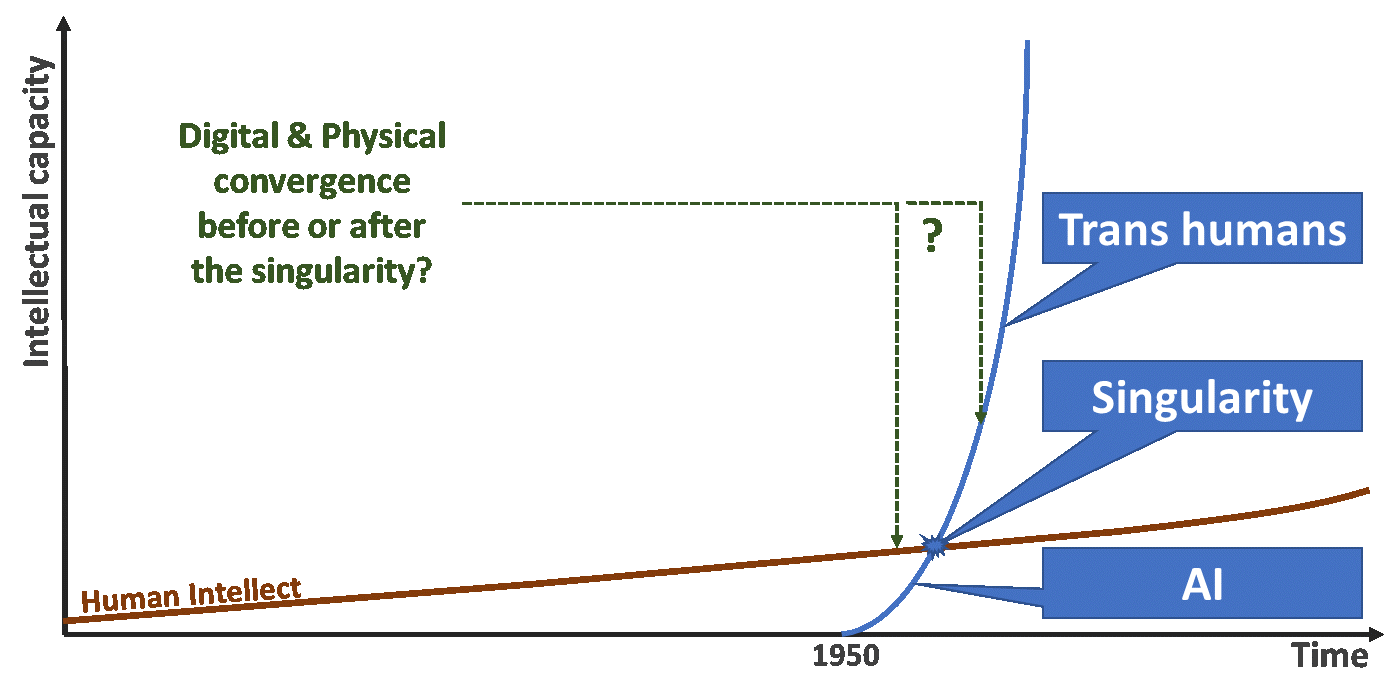
    Before answering that let’s get some basics outlined first on what we mean with Technical Singularity and the physical and virtual world convergence.

    Technical Singularity

    The singularity, ergo that machine can build machines by themselves would not be so concerning if they would run in isolation without connection to the physical world.

    This 3 min Tedx talk from Jason Silva is a good introduction to the subject with a non alarmist tone

    If you are interested in more depth about Technical Singularity I strongly recommend to read Life 3.0: Being Human in the Age of Artificial Intelligence a book by the Swedish-American cosmologist Max Tegmark from MIT. He is also the co-founder of the Future of Life Institute (great site to visit), and has with donations from Elon Musk investigates the existential risk from advanced artificial intelligence. If you find his 796 pages overwhelming there is a 34 min pod as an alternative.

    If you prefer something even easier to digest, the scenario depicted in the books Prelude is similar to the movie Transcendence.

    http://www.imdb.com/title/tt2209764/

    Physical and virtual world converging or Dual Reality

    Interestingly enough the technical Megatrend that the physical and virtual is converging is not at al as well explored and written about as the Technical Singularity. Probably because there is not one big key event that is expected to happen but rather this Megatrend is the sum of many sub-trends and enablement such as:

    • AI and machine intelligence as covered above
    • Mixed reality capabilities in the broadest sense where machines are able to stimulate our sense´s generally in a one directional way even with some feed-back loops
    • Biosyncing / biomedical engineering where human and machine are connected with reciprocal feed-back lops (such as a pace maker)
    • Neural engineering where we can connect our brain directly with the virtual world for a bi-directional exchange of data
    • IoT and connected devices where over time most our machines, buildings, cars are connected
    • IoT smart sensor and actuators where you can collect almost any data from the physical world as well as interacting with it
    • Edge/Mist/Fog/Grid computing to make sure that there is always enough computing power with minimal latency or bandwidth limitations

    The best and simplest overview on the subject I have found is a Australian Consultancy firm called Emergent // Future that has written the paper together with Denis Hurley that is Director Future Technologies at Pearson.

    There is a  MIT publication from 2009 (not a light reading) that labels the merger “Dual Reality”. I have also picked up others label this “Mixed Reality”. On one hand I like Dual/Mixed Reality because it is a short and snappy label for the trend. On the other hand it still suggest this two worlds are clearly separable, true for the foreseeable future but with the latest Biomedical / Neural Enginering the questions is for how long . nevertheless I really like their proposed definition:

    ” The convergence of sensor networks and virtual worlds not only as a possible solution to their respective limitations, but also as the beginning of a new creative medium. In such a “dual reality,” both real and virtual worlds are complete unto themselves, but also enhanced by the ability to mutually reflect, influence, and merge by means of sensor/actuator networks deeply embedded in everyday environments.”

    – Joshua Lifton and Joseph A. Paradiso, MIT Media Lab

    Reflection

    No one can tell exactly when this two mutually supporting events will happen where a god guess is that my grand children will see them both during their lifetime

    It is when the AI could access all of the current physical realms that things get delicate. Imagine your brain is connected (yes in 2017 a human brain was connected as a IoT device). Lets then assume that a AI can tamper with your brain perception of reality. The singularity in that scenario becomes far more concerning (think Matrix) than for example today where a AI would have a limited access (still big enough to cause lots of concerns) to the physical word.

    So what could we learn from a 7 year old child in terms of  bothering already today about the upcoming singularity and convergence between the artificial and real world?

    From a business perspective if your business is not actively exploring the opportunities of the smart society (broader concept than Digitalization) you are likely working in one of the +40% of companies that will not make the leap to the smart society. As employee in such a company it is time to look for a better place to work. I have already in my investments started to assess what companies I believe will make the leap or not.

    From a private perspective I would already today think about all my connected devices and check how secure they actually are and what personal data do they collect. Nowadays I always perform a security check on any connected device and past 2 years suggest my kids toys are the worse among in general poorly designed IoT devices. Even my home alarm system (one of the most frequent in Sweden) wanted to open up a permanent port in my firewall, not a good idea. I received a IoT based water meter where I realized that data would be perfect for a burglar to tap on to figure out if anyone is home, fortunately it had really good security. That water meter is also a very good example of the benefits with connected devices as my water company at no additional cost today offers leakage warnings based on AI monitoring my consumption, that feels good as I have had leakages in the past.

    My last advice is that your wearable are among the worst in terms of collecting private data. I assume no one missed the connected sex toys (several cases) that where collecting way more data than anyone would imagine, not fun when the hackers get hold of that type of information. At the same time my connected fitness watch has prompted me twice while writing this text I needed to take a break and that is great for my health.

    May the force be with you

    /FvG

    PS: If you have read this far I would really appreciate if you drop a line on your spontaneous thoughts and reflections, I would find that motivating and enriching.