
That question is probably not the most common question from a 7-year-old girl. She asked it as she was concerned the AI’s will take over before her next birthday. My 17-year-old kid has also educated her in never publishing a picture where AI face recognition could tag her. Hence as you can see she heavily distort any pictures she publish. So in terms of AI maturity and insights she is more AI mature than many adults.
Is she right to already now ponder on this topic?
Before answering that let’s get some basics outlined first on what we mean with Technical Singularity and the physical and virtual world convergence.
Technical Singularity
The singularity, ergo that machine can build machines by themselves would not be so concerning if they would run in isolation without connection to the physical world.
This 3 min Tedx talk from Jason Silva is a good introduction to the subject with a non alarmist tone
If you are interested in more depth about Technical Singularity I strongly recommend to read Life 3.0: Being Human in the Age of Artificial Intelligence a book by the Swedish-American cosmologist Max Tegmark from MIT. He is also the co-founder of the Future of Life Institute (great site to visit), and has with donations from Elon Musk investigates the existential risk from advanced artificial intelligence. If you find his 796 pages overwhelming there is a 34 min pod as an alternative.
If you prefer something even easier to digest, the scenario depicted in the books Prelude is similar to the movie Transcendence.
http://www.imdb.com/title/tt2209764/
Physical and virtual world converging or Dual Reality
Interestingly enough the technical Megatrend that the physical and virtual is converging is not at al as well explored and written about as the Technical Singularity. Probably because there is not one big key event that is expected to happen but rather this Megatrend is the sum of many sub-trends and enablement such as:
- AI and machine intelligence as covered above
- Mixed reality capabilities in the broadest sense where machines are able to stimulate our sense´s generally in a one directional way even with some feed-back loops
- Biosyncing / biomedical engineering where human and machine are connected with reciprocal feed-back lops (such as a pace maker)
- Neural engineering where we can connect our brain directly with the virtual world for a bi-directional exchange of data
- IoT and connected devices where over time most our machines, buildings, cars are connected
- IoT smart sensor and actuators where you can collect almost any data from the physical world as well as interacting with it
- Edge/Mist/Fog/Grid computing to make sure that there is always enough computing power with minimal latency or bandwidth limitations
The best and simplest overview on the subject I have found is a Australian Consultancy firm called Emergent // Future that has written the paper together with Denis Hurley that is Director Future Technologies at Pearson.
There is a MIT publication from 2009 (not a light reading) that labels the merger “Dual Reality”. I have also picked up others label this “Mixed Reality”. On one hand I like Dual/Mixed Reality because it is a short and snappy label for the trend. On the other hand it still suggest this two worlds are clearly separable, true for the foreseeable future but with the latest Biomedical / Neural Enginering the questions is for how long . nevertheless I really like their proposed definition:
” The convergence of sensor networks and virtual worlds not only as a possible solution to their respective limitations, but also as the beginning of a new creative medium. In such a “dual reality,” both real and virtual worlds are complete unto themselves, but also enhanced by the ability to mutually reflect, influence, and merge by means of sensor/actuator networks deeply embedded in everyday environments.”
– Joshua Lifton and Joseph A. Paradiso, MIT Media Lab
Reflection
No one can tell exactly when this two mutually supporting events will happen where a god guess is that my grand children will see them both during their lifetime
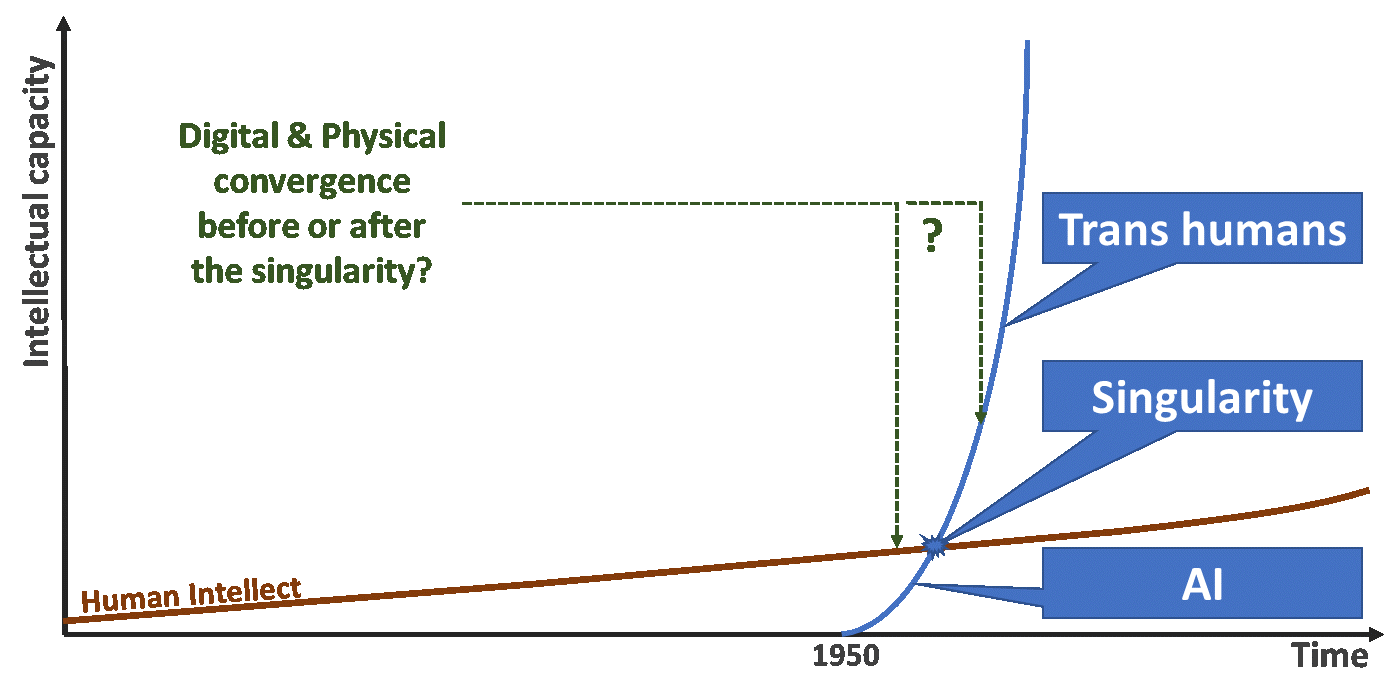
It is when the AI could access all of the current physical realms that things get delicate. Imagine your brain is connected (yes in 2017 a human brain was connected as a IoT device). Lets then assume that a AI can tamper with your brain perception of reality. The singularity in that scenario becomes far more concerning (think Matrix) than for example today where a AI would have a limited access (still big enough to cause lots of concerns) to the physical word.
So what could we learn from a 7 year old child in terms of bothering already today about the upcoming singularity and convergence between the artificial and real world?
From a business perspective if your business is not actively exploring the opportunities of the smart society (broader concept than Digitalization) you are likely working in one of the +40% of companies that will not make the leap to the smart society. As employee in such a company it is time to look for a better place to work. I have already in my investments started to assess what companies I believe will make the leap or not.
From a private perspective I would already today think about all my connected devices and check how secure they actually are and what personal data do they collect. Nowadays I always perform a security check on any connected device and past 2 years suggest my kids toys are the worse among in general poorly designed IoT devices. Even my home alarm system (one of the most frequent in Sweden) wanted to open up a permanent port in my firewall, not a good idea. I received a IoT based water meter where I realized that data would be perfect for a burglar to tap on to figure out if anyone is home, fortunately it had really good security. That water meter is also a very good example of the benefits with connected devices as my water company at no additional cost today offers leakage warnings based on AI monitoring my consumption, that feels good as I have had leakages in the past.
My last advice is that your wearable are among the worst in terms of collecting private data. I assume no one missed the connected sex toys (several cases) that where collecting way more data than anyone would imagine, not fun when the hackers get hold of that type of information. At the same time my connected fitness watch has prompted me twice while writing this text I needed to take a break and that is great for my health.
May the force be with you
/FvG
PS: If you have read this far I would really appreciate if you drop a line on your spontaneous thoughts and reflections, I would find that motivating and enriching.

You must be logged in to post a comment.