Category: Quick reflections

Scattered thoughts

  • Why the Covid-19 pandemic will be your lifetimes most disruptive event and we do not yet know by how much

    Why the Covid-19 pandemic will be your lifetimes most disruptive event and we do not yet know by how much

    We have now passed the point of where Covid-19 will accelerate the change of our society. The Corona crisis is a black swan event, and even if we do not know how deep and long the impact will be on our economy, it will be transformational and in this post I will outline why.

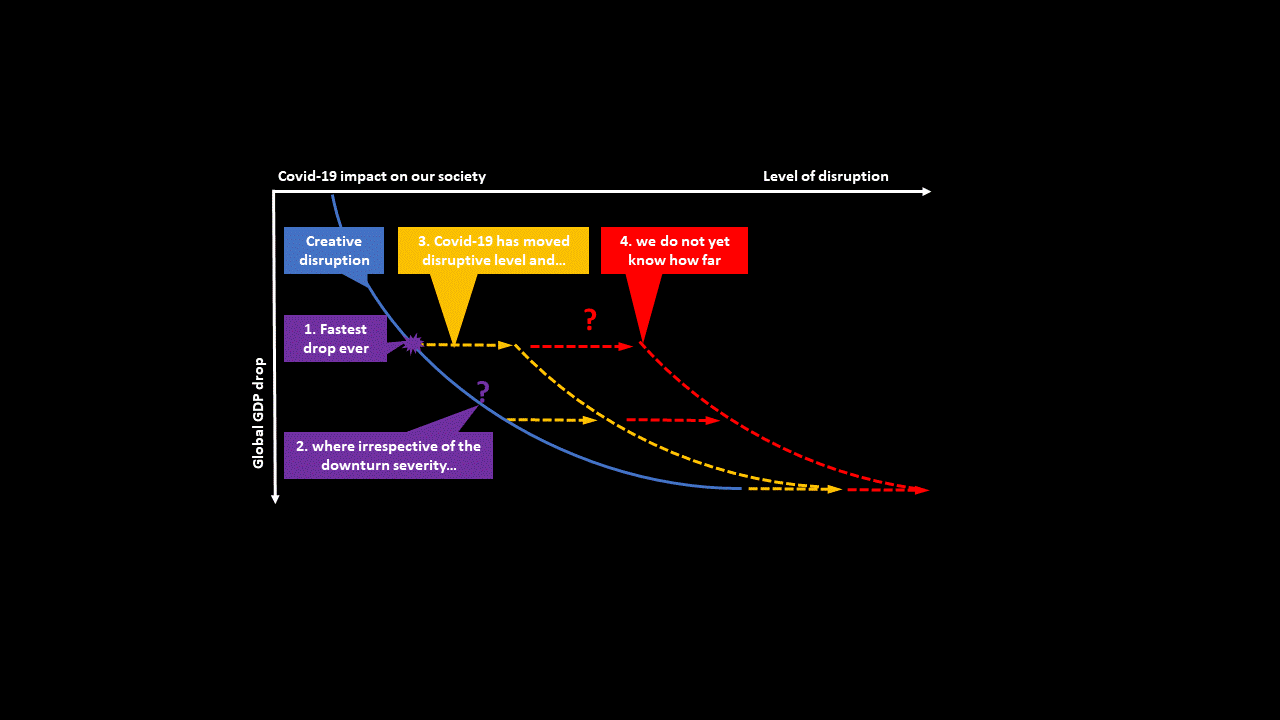
    Covid-19 level of impact on our society in relation to drop in GDP

    What are my arguments?

    Let me start by presenting why I make the statement that the Covid-19 pandemic will have a significant impact on our society even in the best case scenario where we would soon start to recover both from the health impact as well as the economical crisis:

    • We where about to change anyway entering the 6th wave of innovation (se below) where late adopters of digitalization (80% of companies) will be left behind by the most agile one
    • The pandemic grip of our society until we get a widely distributed vaccine, where the experts suggest best case is next 1-3 years:
      • The impact of containment measures even if they probably will be less intrusive over time as we find better method and tools
      • The concern about being infected for the elderly (+70) and the one with pre-existing conditions
      • Among family and friends the concern about anyone loved that are in the risk group
    • The fastest decline in the global economy surpassing even the depression of the 30´s, where even if it bounces back faster than the financial crisis of 2008, it has has traits we have never seen before:
      • The drop has been so sharp that analyst says even the forward looking KPI’s (for example consumer confidence or buyer index) are not able to adequately monitor the drop and the main backward looking measures (for example unemployment or GDP ) has not yet fully started to pick up the depth of the economical downturn
      • The largest ever increase of unemployment in the US with +6 millions filling for unemployment benefits by 4/4
      • First time ever mass impact on Small and Medium sized business (SMB) across the globe that usually are the buffers in a downturns due to their flexibility of adapting and finding new market positions
    • The relationship changes between states and their citizens:
      • Trust in the public sector to handle the crisis especially for the health sector
      • Citizens of democracies accepting authoritarian government type of restrictions on their personal freedom of movement for the greater good
      • Social distress in developing countries due to governmental containment measures
      • Non democratic governments exploring the situation (like Hungary)
    • The impact of half the world population living under various degree of containment measures:
      • School and business shut downs
      • Isolation affect on peoples mental health
      • The emergence of new stay at / work from home habits, products and services
      • Realization of the need to stockpile food and emergency supplies
    • The digitization taking a leap forward reaching both:
      • Countries with for example e-learning for schools but also monitoring the populations compliance with containment measures
      • Companies and organisation learning how to work in virtual teams from a distance
      • New groups of users for example elderly using smart phones video conference to keep in touch with friends and families or ordering food online (like my 82 year old grandfather figured out how to do by himself, I am very proud)
    • The return to normal in China and Asia show things are going back to a new normal:
      • Maintained social distancing, the use of face masks in public and live by the smart phone traffic light system for how you are allowed to move and travel
      • The surveillance state has taken a new level and many other countries are trying to copy with various respect for the personal integrity
      • Impact on the Chinese economy with expectation, for the first time ever post the revolution, a quarter with recession numbers, including a weak international demand
      • Increased skepticism for foreigners and concern for import cases of Corona
    • The science community coming together towards a common goal to save us against an invisible enemy:
      • Experts that has warned about the risk for a pandemic since mid 90’s and Bill Gates bringing it to our attention since 2015 are now being listened to where we will hopefully plan much better for the next pandemic
      • New ecosystems of researches and companies being created
    • The Anti-Globalization movement, already in acceleration with past year trade wars, has just had it’s perfect storm with:
      • Disruption of global supply chains
      • Nationalistic behavior for critical health care equipment even within the EU and between the US and the rest of the world
      • The dependence upon China has been a wake up call with China’s increasing soft power for many sector notably the manufacturing of medical supply
      • Increasing protectionism with a concern China will use the opportunity to buy companies at the brink of bankruptcy
    • The environment connection is already there even if the short term impact is limited:
      • Skies are clearing, Venice waters are blue and clear, animals and pedestrians are taking back the streets and I do not any longer hear all the planes take off and land from my garden
      • There is probably a correlation between Corona impact and air pollution, pollution that by the way kills ~8 million people per year
      • There will be two opposing forces:c i) one that drives the need to relax environmental transformation to help recover the economy and ii) I hope the stronger side winning the argument that the recovery from the Covid-19 is a golden opportunity to make a environmental leap forward
      • How eager will people be to travel after they have seen how people got stuck abroad, lost money on already booked travels and the data on how the epidemic was spreading across Europe from after ski in the Alps

    What you have to believe to accept my line of thinking

    The natural edge project 2004 adaptation of Schumpeter’s ‘Business Cycles’ (1939)

    I think the adaptation of Schumpeter’s ‘Business Cycles’ from 1939 by the Natural Edge Project in 2004 is really good as a the hypothesis for why the crisis would be transformational in all scenarios. As you can notice the assumption is that each cycle will become shorter. The 5th era of 30 years of digitization is at it’s end and that the 6th one that has just started would last som 25 years, The theory is also that the complexity of innovation is increasing.

    So what is next?

    I think it is a little to early to predict with any precision what the outcome will be but that does not prevent taht we can figure out a few things (that are also good ideas for new posts):

    • The continued need, impact and length for containment measures has the capacity to further push the curve in my graph above to the right and thereby increase the transformation force for any given downturn scenario
    • The deeper and longer the financial downturn last will further fuel the level of transformation (as it follows the curve in the graph)
    • Existing mega trends (for example digitization) will generally accelerate while some might lose momentum or take new turns (perhaps Globalization being counterbalanced with Regionalization). A few trends could be unaffected while we will over time will se how the crisis also has caused new mega trends to emerge
    • The defining moment for our planet will be what happens with the transformation towards a more sustainability society, a hopefully smarter society

    PS: Some claim Covid-19 is not a black swan (something we could not see coming) and instead that we where just lucky that we closely escaped SARS and Ebola that could had been as bad as Covid-19 but we did not really learn from it.

  • Help with your pathway to inner balance in the Smart Society? Explore Arianna Huffingtons initiative “Thrive Global” as a remedy

    Help with your pathway to inner balance in the Smart Society? Explore Arianna Huffingtons initiative “Thrive Global” as a remedy

    You have probably read loads of self improving literature such as Stephen R. Covey’s book, The 7 Habits of Highly Effective People® or Edward de Bono, the author of The Six Thinking Hats even if I think for example Plato or Heidegger has more to give in terms of human purpose or thinking.

    What I really like with Arianna Huffingtons initiative “Thrive Global” is that they help you translate all that self-improvement insights into actionable outcomes in todays changing society.

    “Thrive Global’s mission is to end the stress and burnout epidemic by offering companies and individuals sustainable, science-based solutions to enhance well-being, performance, and purpose, and create a healthier relationship with technology.”

    You might already have heard about some of their apps where your phone will stop your feeds and even let others know about it

    https://thriveapp.thriveglobal.com/

    Reflection

    One of their posts actually triggered this post and is about how Deep Thinking In The Age of Distraction with the subtitle: “Disconnect. Your imagination, creativity and next big idea depends on it.”

    It made me reflect that the time I spend on researching and writing my post and articles is one of my ways to log out and spend focused time on thinking and reflecting and from time to time come up with new thoughts, ideas and perspectives.

    It also reinforced my view that I want to offer you as a reader a site that is not overly busy, free from ads and neither is selling you something. I also want to create content that triggers your own reflection and  to do that I try to avoid to push a very strong opinion and instead offer more of: “On one side and on the other side”

    It is often tempting to create material that is more of a click bait with “5 steps to the Smart Society” or “This is why most companies will fail to become Smart Companies”.

    I also realize that I am far from maximizing my social media use in terms of creating provocative material that will raise comments (that will increase the post exposure) or go in and like other post in an expectation they will do the same back.

    If you have read this far I have three favors to ask you:

    1 – Please give some feed-back in this short pol to help me develop the post and the site:

     2 – Link to this site or favorite posts from your social media platforms

    As I need all the help I can get to reach out (you have links to most social media further down on the page).

    Especially to become spread LinkedIn posts needs both likes and comments.

    3 – Subscribe

    You find the link in the right upper column to subscribe per mail and I commit to trigger not more than 3 mails per week and typically I post only twice a week.

    You can also follow me on Twitter  or WordPress where you have all posts or LinkedIn (but where their AI only show a post to 10 % of my follower and based on their reaction makes a call how many will see the post).

  • The Winner takes it all in the Digital Capitalism – Good or Bad?

    The Winner takes it all in the Digital Capitalism – Good or Bad?

    Already in 2009 Digital Capitalism  (Networking the Global Market System – Dan Schiller – MIT Press, 1999) predicted the rise of a few US-based platform companies with scaring accuracy based upon an analysis of a number of structural aspects.

    The book is still very relevant and I thought it was a good start to reflect if Digital Capitalism is helping or not to create a Smarter Society.

     Here is a short version of the books prediction

      • A sys­tem cre­ated by mar­ket forces to serve mar­ket forces can only deepen ex­ist­ing so­cial in­equities and even them out
      • Tra­di­tional net­work (In­ter­net) poli­cies has been gen­er­ally pro­tec­tion­ist, na­tion­al­ist, and so­cially ori­ented
      • Net­work ad­vo­cates ap­plied po­lit­i­cal pres­sure to change pro­tec­tion­ist network poli­cies into neo-liberal poli­cies
      • Net­work re­form began in the United States and moved into de­vel­oped and de­vel­op­ing na­tions
      • Net­work dereg­u­la­tion has re­sulted in neg­a­tive so­cial and wel­fare consequences
      • The In­ter­net deep­ens and widens the reach of cap­i­tal­ism
      • The dig­i­tal cap­i­tal­ist net­work pri­mar­ily ben­e­fits transna­tional cap­i­tal
      • Com­mer­cial net­work de­vel­op­ment has had a neg­a­tive im­pact on the so­cial and wel­fare po­ten­tial of the In­ter­net
      • Com­mer­cial net­work de­vel­op­ment has had a neg­a­tive im­pact on higher ed­u­ca­tion

    How good was the books prediction?

    A good blog with the label:  FAMGA (Facebook, Apple, Microsoft, Google, Amazon) Is Eating The World and The Profound Implications of Five Increasingly Dominant Tech Companies, further deepens on the subject that we are in a “The winner takes it all situation”. So on this subject did Dan Schiller a good prediction.

    With the latest move in the US to potentially twist network neutrality this opens the door even further for the large corporation to make it more difficult for competing start-ups to emerge. So the risk for increased barriers for new digital companies to enter is quite likely. Some good thoughts about this could be read at The future of US net neutrality under Trump. Hence this is another area where Dan Schiller spotted where things where heading.

    All of the big us firms lately are racing to become the center of our home and life (Google Home, Amazons Echo, Apples Homepod, Microsoft’s Cortana, Facebook had M but has recently given up the race) with the ability to continuously monitor what we do and say, that does not feel particular attractive to me as an individual. If you want to read more about the risks Symantec has published a very good paper on the topic.

    The US-based firms are also key players in investing into AI. I have not found any solid source of data on how the spread of AI investments but several sources put the FAMGA in the top 10 of AI investments (US News, Investors.com, Investopedia, Techworld). Where except Baidu a couple of other US-based firms appears such as: IBM, NVIDIA and Netflix.

    So to sum it up there is a clear risk we are going to end up in the dystopian world of many futuristic movies where a few large (and typically evil) corporation rules the world with AI at their disposal. The Winner takes it all is over time not enriching for neither the society nor me as an individual as it only streamlines what we are offered.

    To balance above statement at least some evidence this companies, even if shareholder value are their long-term goal, that they from time to time voluntarily avoid the worst case scenarios. To mention a few concrete ones: Apple is usually trying to respect their users integrity (at least more than the others) and give them many settings on what to share and not, Facebook is lately trying to address filter bubbles and fake media, Google is offering their Google Docs to the use of many organisations and people at limited cost, Amazon is obsessed with Customer satisfaction and do trade of short-term profit. I just hope the sum of that takes us into the green quadrant of the chart below.

    Reflection

    The only thing I think Dan Schiller missed was the rise, partly behind the great Chines firewall, of the Asian digital companies. Cognizant published in 2015 an excellent paper called Asian Rising: Digital Driving with clear facts that Asia is fast becoming the center of digital innovation for the world.

    “The region accounts for half of the world’s total 2.8 billion Internet users, and it is already the largest regional e-commerce market.”

    On the other hand, if you apply his structural approach, you will quickly come to realise that a very similar patterns to the one he discovered for the US-based firms, also is true for the Asian based companies, even if they have their own version of Digital (state controlled) capitalism.

    With a European perspective I see few real challenger in Europe to US-based companies dominance. To be honnest I am not sure it is better for neither me as an individual nor our society to become dominated by Asian based and often governmentally influenced companies as an alternative.

    The question is if there will emerge any counter balancing power, perhaps with some help from EU or local governments, to level the play field? At the same time we need to balance on the thin line between sub optimized protectionism and globalism with fair play. The business Europe, a European business federation are trying to drive the idea of the EU digital single market where EU has started to work on policy making.

    I think the most important thing would be legislation and platforms to give us as people back the ownership of our data and that we over time would start to create platforms where we can control and sell that data.

    So what to do tomorrow to prepare for the future?

    From a business end I would always plan to play ball with the big US-based corporations but try to also seek opportunities with the Asian challengers when you define your digital strategy. You need to at least consider how they could impact your market? As long as the big US companies or Asian challengers has not entered your market unfortunately the Winner takes it all rules in your niche as well. Either you are working at the Winning company or time to look for a job somewhere else.

    From an Individual perspective I am always cautious how much data I share with the US-based companies (or any company actually). And I am waiting until I can run my AI assistant before I’ll start to use them to any larger extent, especially at home. I appreciate all companies that build solution with my integrity in the center and use that as a key selection criteria for what to buy.

    Great if you want to drop a line of what you think or reflect after reading this article, that is quite motivating.


  • The Spotify AI found me the soundtrack of the Digital to Physical convergence

    The Spotify AI found me the soundtrack of the Digital to Physical convergence

    I would actually had missed this whole observation and hence post if a collegue of mine would not had made a good post that we often look too far in the future instead of focusing on the here and now. He suggested we should start create the Smart Society for example by just making our office Smarter as a start. This whole thought of his sparkled my mind while out walking and realizing the album Spotify had just proposed was the perfect soundtrack for when the Digital and Physical converges.

    The album is with my musical taste the perfect blend of acoustic and electronic instruments and hence is the musical representation and soundtrack for the convergence

    The whole thing also made me realize that the Spotify despite my mix of many allas narrow musical preferences very driven by my listening mood nowadays with four very different Daily Mix most of the time makes a good jobb. That also includes in most of the mixes to avoid overly lyrically driven songs even if I do not only listen to instrumental material as well as my inclination to discover new music. Still a couple of times per month it will throw me something I really do not like but it is definitely worth the hassle for all the good new music it helps me discover.

    Spotify Algoritms and I go way back

    Up until two years ago the Spotify algoritms and myself where not the best of palls. My music taste as described above made any deep learning algoritm fail and would mix song that for me fits to different moods. I know my friends over at Spotify has made a lot of effort the adress that and for me it know works most of the time.

    On the other hand the progress is not only to the merit of the Spotify team. I have since the start of their radio stations I think back in 2012 spent many hours or swiping away songs I did not enjoy and I would expect there is a waste library of what I have liked and not to data mine.

    AI learning from this story?

    Well actually more than it could appear so let me summarize it in 3 observations

    1. Developing good AI requires time and effort in a persistent continuous improvement mindset. Just consider the time, resources and computing power for the Alfa Go team to make a AI play a boardgame.
    2. For the final tuning you need human interaction to help the AI when it has not done a good jobb. Just like in my Spotify story where even if the AI has analyzed thousand of my listening hours from many years of consumption of the service it still needs intervention from my side to guide it.
    3. AI will in the short future be consumed by us a individual and companies through existing platform providers. They are the one to have the user scenarios where to apply AI, they have the user base to justify the investment and they have the large amount of data needed to feed the AI with

    Sadly I think many companies are now engaging into the AI domain not being clear on the above observations and hence are quite likely to fail. But hey, we could assume that is just part of the AI hype cycle

    Curious on the soundtrack that this is all about? It was Portico Quartet and the album Age of Automation

  • I dream about the day I no longer have to talk about digitalization

    I dream about the day I no longer have to talk about digitalization

    The foundation of Digitalization started already in late 60´and early 70´and already back then there where forward looking thinkers realizing the profound effect it would have on society over time. But as general with trends the transformation speed is over estimated in the beginning and the effect over time under estimated

    I started to work late 90′ and have ever since worked with how companies can use modern technology to become more competitive. Somewhere around 2000 with the Y2K and dotcom boom some enclaves of people around myself started to talk about digitalization as something separate from that, typically people within marketing and sales discovering how the internet would redefine how they had to work. Steadily and slowly digitalization as a term has spread.

    Google search interest index for Digitalization.png

    Somewhere 2012 I realized I hade to merge what I had been doing for long into the framework of Digitalization to not be perceived as outdated.

    Nowadays Digitalization is used anywhere from newspapers explaining why people lose jobbs to leadership (with a few exceptions) teams trying to figure out how to orient themselves

    When our digital native generations get kids they will probably no longer even consider te difference between a analogue and digital world as they will convert and merge.

    I believe as the effects of Digitalization is spreading across all of the societies domains it will soon become obsolete to talk about the Digitalization as something separate to our everyday life. What organization are not to some extent using modern technologies in their operation? Most consumers expect seamless integration between the web experience and the physical experience

    Out of convenience I  use the term multiple times a day to communicate to others why they have to change and what they need to do. I have it on my Linkedin profile to be searchable, my business unit has it in its name, my current assignment has it as a objective

    My instinct is that we should already today start to think and organize us as that convergence of the real world and digital has already happened. Keeping digitalization as something you do separate, outside the day to day risk to be more of a respirator to the patient rather than actually addressing the challenges that makes many organisation struggling during changing times. There is so much of poor leadership, missing focus on the customer journey, lack of clarity on competitive business models, old school governance and organisations that if you just adress this first, the digitalization will come as a side product.

    I will as of tomorrow do my best to significantly reduce how often I use the word Digitalization and force myself to find other terms instead