Category: Reflections

  • Daddy when will we reach singularity?

    Daddy when will we reach singularity?

    That question is probably not the most common question from a 7-year-old girl. She asked it as she was concerned the AI’s will take over before her next birthday. My 17-year-old kid has also educated her in never publishing a picture where AI face recognition could tag her. Hence as you can see she heavily distort any pictures she publish. So in terms of AI maturity and insights she is more AI mature than many adults.

    Is she right to already now ponder on this topic?

    Before answering that let’s get some basics outlined first on what we mean with Technical Singularity and the physical and virtual world convergence.

    Technical Singularity

    The singularity, ergo that machine can build machines by themselves would not be so concerning if they would run in isolation without connection to the physical world.

    This 3 min Tedx talk from Jason Silva is a good introduction to the subject with a non alarmist tone

    If you are interested in more depth about Technical Singularity I strongly recommend to read Life 3.0: Being Human in the Age of Artificial Intelligence a book by the Swedish-American cosmologist Max Tegmark from MIT. He is also the co-founder of the Future of Life Institute (great site to visit), and has with donations from Elon Musk investigates the existential risk from advanced artificial intelligence. If you find his 796 pages overwhelming there is a 34 min pod as an alternative.

    If you prefer something even easier to digest, the scenario depicted in the books Prelude is similar to the movie Transcendence.

    http://www.imdb.com/title/tt2209764/

    Physical and virtual world converging or Dual Reality

    Interestingly enough the technical Megatrend that the physical and virtual is converging is not at al as well explored and written about as the Technical Singularity. Probably because there is not one big key event that is expected to happen but rather this Megatrend is the sum of many sub-trends and enablement such as:

    • AI and machine intelligence as covered above
    • Mixed reality capabilities in the broadest sense where machines are able to stimulate our sense´s generally in a one directional way even with some feed-back loops
    • Biosyncing / biomedical engineering where human and machine are connected with reciprocal feed-back lops (such as a pace maker)
    • Neural engineering where we can connect our brain directly with the virtual world for a bi-directional exchange of data
    • IoT and connected devices where over time most our machines, buildings, cars are connected
    • IoT smart sensor and actuators where you can collect almost any data from the physical world as well as interacting with it
    • Edge/Mist/Fog/Grid computing to make sure that there is always enough computing power with minimal latency or bandwidth limitations

    The best and simplest overview on the subject I have found is a Australian Consultancy firm called Emergent // Future that has written the paper together with Denis Hurley that is Director Future Technologies at Pearson.

    There is a  MIT publication from 2009 (not a light reading) that labels the merger “Dual Reality”. I have also picked up others label this “Mixed Reality”. On one hand I like Dual/Mixed Reality because it is a short and snappy label for the trend. On the other hand it still suggest this two worlds are clearly separable, true for the foreseeable future but with the latest Biomedical / Neural Enginering the questions is for how long . nevertheless I really like their proposed definition:

    ” The convergence of sensor networks and virtual worlds not only as a possible solution to their respective limitations, but also as the beginning of a new creative medium. In such a “dual reality,” both real and virtual worlds are complete unto themselves, but also enhanced by the ability to mutually reflect, influence, and merge by means of sensor/actuator networks deeply embedded in everyday environments.”

    – Joshua Lifton and Joseph A. Paradiso, MIT Media Lab

    Reflection

    No one can tell exactly when this two mutually supporting events will happen where a god guess is that my grand children will see them both during their lifetime
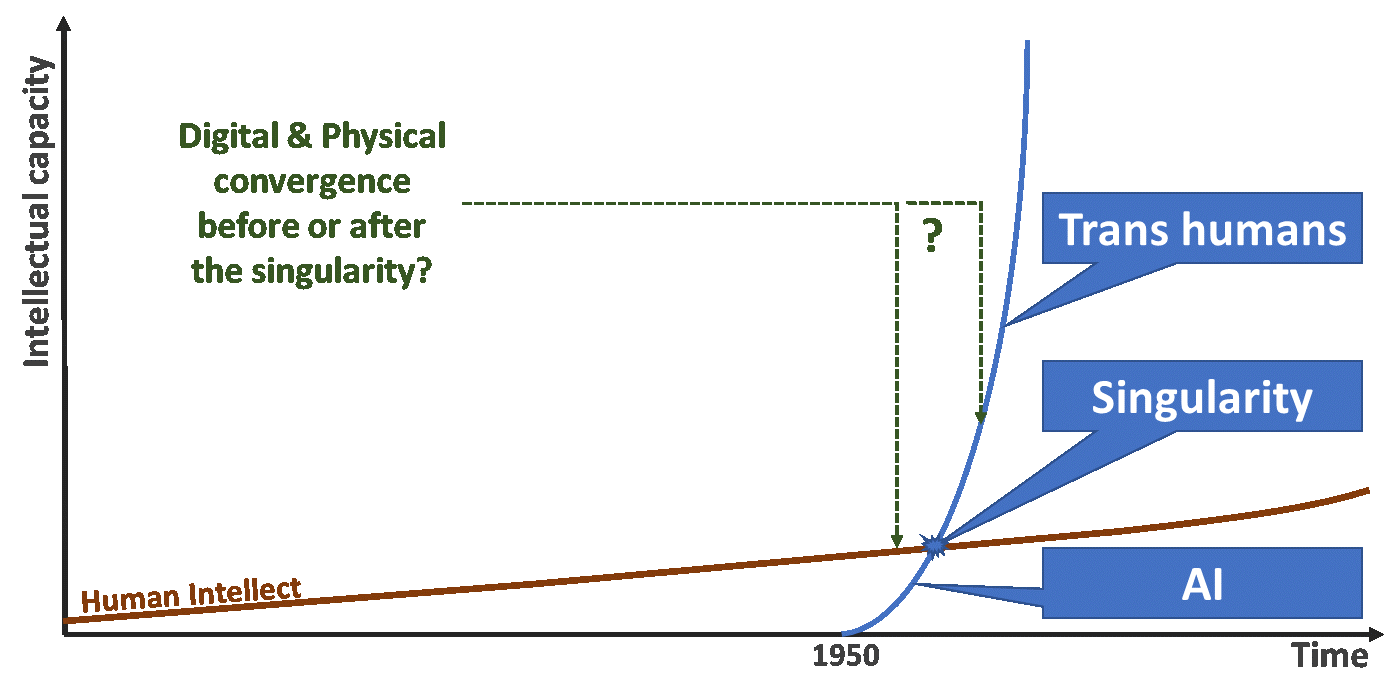
    It is when the AI could access all of the current physical realms that things get delicate. Imagine your brain is connected (yes in 2017 a human brain was connected as a IoT device). Lets then assume that a AI can tamper with your brain perception of reality. The singularity in that scenario becomes far more concerning (think Matrix) than for example today where a AI would have a limited access (still big enough to cause lots of concerns) to the physical word.

    So what could we learn from a 7 year old child in terms of  bothering already today about the upcoming singularity and convergence between the artificial and real world?

    From a business perspective if your business is not actively exploring the opportunities of the smart society (broader concept than Digitalization) you are likely working in one of the +40% of companies that will not make the leap to the smart society. As employee in such a company it is time to look for a better place to work. I have already in my investments started to assess what companies I believe will make the leap or not.

    From a private perspective I would already today think about all my connected devices and check how secure they actually are and what personal data do they collect. Nowadays I always perform a security check on any connected device and past 2 years suggest my kids toys are the worse among in general poorly designed IoT devices. Even my home alarm system (one of the most frequent in Sweden) wanted to open up a permanent port in my firewall, not a good idea. I received a IoT based water meter where I realized that data would be perfect for a burglar to tap on to figure out if anyone is home, fortunately it had really good security. That water meter is also a very good example of the benefits with connected devices as my water company at no additional cost today offers leakage warnings based on AI monitoring my consumption, that feels good as I have had leakages in the past.

    My last advice is that your wearable are among the worst in terms of collecting private data. I assume no one missed the connected sex toys (several cases) that where collecting way more data than anyone would imagine, not fun when the hackers get hold of that type of information. At the same time my connected fitness watch has prompted me twice while writing this text I needed to take a break and that is great for my health.

    May the force be with you

    /FvG

    PS: If you have read this far I would really appreciate if you drop a line on your spontaneous thoughts and reflections, I would find that motivating and enriching. 


  • The Spotify AI found me the soundtrack of the Digital to Physical convergence

    The Spotify AI found me the soundtrack of the Digital to Physical convergence

    I would actually had missed this whole observation and hence post if a collegue of mine would not had made a good post that we often look too far in the future instead of focusing on the here and now. He suggested we should start create the Smart Society for example by just making our office Smarter as a start. This whole thought of his sparkled my mind while out walking and realizing the album Spotify had just proposed was the perfect soundtrack for when the Digital and Physical converges.

    The album is with my musical taste the perfect blend of acoustic and electronic instruments and hence is the musical representation and soundtrack for the convergence

    The whole thing also made me realize that the Spotify despite my mix of many allas narrow musical preferences very driven by my listening mood nowadays with four very different Daily Mix most of the time makes a good jobb. That also includes in most of the mixes to avoid overly lyrically driven songs even if I do not only listen to instrumental material as well as my inclination to discover new music. Still a couple of times per month it will throw me something I really do not like but it is definitely worth the hassle for all the good new music it helps me discover.

    Spotify Algoritms and I go way back

    Up until two years ago the Spotify algoritms and myself where not the best of palls. My music taste as described above made any deep learning algoritm fail and would mix song that for me fits to different moods. I know my friends over at Spotify has made a lot of effort the adress that and for me it know works most of the time.

    On the other hand the progress is not only to the merit of the Spotify team. I have since the start of their radio stations I think back in 2012 spent many hours or swiping away songs I did not enjoy and I would expect there is a waste library of what I have liked and not to data mine.

    AI learning from this story?

    Well actually more than it could appear so let me summarize it in 3 observations

    1. Developing good AI requires time and effort in a persistent continuous improvement mindset. Just consider the time, resources and computing power for the Alfa Go team to make a AI play a boardgame.
    2. For the final tuning you need human interaction to help the AI when it has not done a good jobb. Just like in my Spotify story where even if the AI has analyzed thousand of my listening hours from many years of consumption of the service it still needs intervention from my side to guide it.
    3. AI will in the short future be consumed by us a individual and companies through existing platform providers. They are the one to have the user scenarios where to apply AI, they have the user base to justify the investment and they have the large amount of data needed to feed the AI with

    Sadly I think many companies are now engaging into the AI domain not being clear on the above observations and hence are quite likely to fail. But hey, we could assume that is just part of the AI hype cycle

    Curious on the soundtrack that this is all about? It was Portico Quartet and the album Age of Automation

  • Are social media good or bad? Time to make your personal call!

    Are social media good or bad? Time to make your personal call!

    As all technology also social media can be put to both good and bad

    With the significant impact of social media where they also becomes a filter in our social interaction with others I think important to reflect upon how we consume and handle social medias.

    Are social media bad?

    If you want to read more on the subject a good start is Humanetech a nonprofit organization that has both some really good analysis on the issues with social medias and a number of concrete proposals for Human centered Technology. You will be greeted on their homepage with the title:

    “Our society is being hijacked by technology”

    http://humanetech.com/

    Interestingly enough is that when i search on google for “Social media positive effects” I get around 35 million hits. Going through the first 3 pages of hits more than half of them are actually not positive but rather balanced and labeled  “Positive and Negative Effects of Social Media”. When I search for “Social media addiction”  I get  72 million hits and very few on the first pages are balanced ergo they have a negative or alarmist angle. So in conclusion we have twice as many hits that Social media are bad than that they are good

    I have also an impression (that I intend to research another time) that there is a growing movement against the negative effects of the dominant social media platforms.  I think part of Georg Soros conversation at World Economic Forum in Davos is a good illustration of this kind of allegations:


    “I want to spend the bulk of my remaining time on another global problem: the rise and monopolistic behavior of the giant IT platform companies. These companies have often played an innovative and liberating role. But as Facebook and Google have grown into ever more powerful monopolies, they have become obstacles to innovation, and they have caused a variety of problems of which we are only now beginning to become aware.”


    If you can not bother to listen to the 45 min conversation I think Business insider has done a very good analysis out of his conversation. Please note I am not endorsing this kind of allegations as I have not made up my mind yet so above quote is just used as illustrative example for that kind of movement

    Model for reflection

    If a topic feel complex and overwhelming my brain has a tendency to try to simplify as far as possible and hence I came up with this simple model  on what scenarios we have ahead of us that could also be used on a personal level

    If you have not heard about Netocraty I strongly suggest you get onto the subject. Netocracy is predict a future new ruling class from two philosophers that so far has had a lot of accurate prediction already back at Y2K

    I use the model above as a simple way to analyze where something (an app, a social media platform,  a business idea, etc) that picks my attention ends up in the quadrant. If it is not clearly green I avoid it as far as I can

    My reflection using the model

    Let me apply the model on my consumption of social media as an illustration of what you can do already now

    On a personal level some +10 years ago when I read the Terms and Conditions while singing up for Facebook where you give them the rights to any material and pictures I thought it was a scam and aborted to sign up. A decision I have not regretted and while typing this post realize that from having been considered an odd person not being on the digital grid, more and more people envy that stance. I assume that is partly due to the above movement that social media are bad. Still today Facebook would clearly end up in the personal negative quadrant as I have very little need for likes or the grapevine of people I long time obviously dropped out with. For my close friend I prefer more private channels such as the phone, mail or direct messenger. For business contacts I very much prefer LinkedIn.

    I have tried Instagram and Twitter but as I prefer loooong reflective text they do not do the trick at all but we are all different so for my mother Instagram has largely replaced her consumption of soap operas.

    Even for this site it was a researched and conscious decision  to have full control of my publishing platform and not depend on other platforms terms and condition, their formating choices nor any screening on the content. I also wanted you as a reader to be able to read without distracting advertising.

    With the latest worse of the bad deepfakes (link to Mashable that explains it well) where with a set of pictures of a person you can get faced swap into any kind of movie (mostly with a target to produce adult material) I am so grateful my teenager has learned the family many year ago how to make sure your posted pictures on social media are not face recognisable. I am also very happy I have taken the fight with every of my children´s childcare and schools that they are not allowed to publish any pictures of my kids. And I appreciate all friends and colleagues that has, perhaps after making fun of me, accepted I do not want to be tagged on their social medias.

    Wrap up

    I strongly believe it is the sum of many people good choices that will help us ensure social medias becomes positive for both us as people as well as for the greater good of society.

    It is probably healthy and I think it will emerge alternatives to some of the dominating platforms with a better human oriented design, perhaps we as user on the other hand need to accept we pay for the service to diminish the need to maximize the time you spend on the platform consuming the advertising.

    One simple thing we could all do is to strive to give towards a smart society (my post the other day) where that concept can be used as framework for how we make sure technology is used to make a better society in general and where we design social media platform with a human oriented design.

    I would appreciate if you share a few lines on your reflection after reading this post, that would be both rewarding and enriching for me. 


  • Digitalization is not to think big, Smart Society is

    Digitalization is not to think big, Smart Society is

    Based upon my earlier post – “I dream about the day I no longer have to talk about digitalization” –  I have thought about what I should use instead of Digitalization as a concept.

    After quite some research and good discussions with a few clever friends of mine I have come to some sort of early conclusion ready for sharing.

    In fact the answer is given as digitalization is not the why but the how and actually only the how in some domains and not all dimensions. So what is the general end vision and purpose of digitalization? Well I think it should be to strive towards a  smarter society. Of course people and organisation will make a somewhat different definition of that why. I also realize that  many of the most successful companies in the transforming world have that why defined for a society where the physical and artificial is converging and where the singularity of artificial intelligence is approaching in a ever accelerating pace.

    I have for past month tried “Smart Society” on people where I would normally use digitalization and it actually works well. When people have asked what I mean with it following definition has evolved:

    Definition (preliminary): The smart society is the socio-technical ecosystem in which the physical and virtual dimensions of life converge and were people interaction is mediated by machines to an ever increasing extent

    I have actually already used the Smart Society perspective to kill of Digitalization proposals that does not stand the lackmus test.

    When you start to think about your day-to-day tasks and queries from a “how does this help make society smarter” you will quickly realize it is a quite powerful in all it’s simplicity.

    Early in my thought process I just assumed with all the buzz around  Smartphones, Smart Cities, Smart manufacturing and all the other Smart something  that I would get an overwhelming amount of hits but were amazed that this was not the case. The most concrete I found is a EU sponsored university driven project founded already in 2013 (so as usual some clever people where quite ahead of the rest of us) that have some interesting publications I plan to explore and comment here.

    To transform all this into something easy to remember  just think of digitalization as one piece of the Smart Society puzzle.

    So next step is to start figure out what other dimensions to add to make this a more complete and usable mental model.


    Feel free to share your thoughts on what those pieces should be.


  • I dream about the day I no longer have to talk about digitalization

    I dream about the day I no longer have to talk about digitalization

    The foundation of Digitalization started already in late 60´and early 70´and already back then there where forward looking thinkers realizing the profound effect it would have on society over time. But as general with trends the transformation speed is over estimated in the beginning and the effect over time under estimated

    I started to work late 90′ and have ever since worked with how companies can use modern technology to become more competitive. Somewhere around 2000 with the Y2K and dotcom boom some enclaves of people around myself started to talk about digitalization as something separate from that, typically people within marketing and sales discovering how the internet would redefine how they had to work. Steadily and slowly digitalization as a term has spread.

    Google search interest index for Digitalization.png

    Somewhere 2012 I realized I hade to merge what I had been doing for long into the framework of Digitalization to not be perceived as outdated.

    Nowadays Digitalization is used anywhere from newspapers explaining why people lose jobbs to leadership (with a few exceptions) teams trying to figure out how to orient themselves

    When our digital native generations get kids they will probably no longer even consider te difference between a analogue and digital world as they will convert and merge.

    I believe as the effects of Digitalization is spreading across all of the societies domains it will soon become obsolete to talk about the Digitalization as something separate to our everyday life. What organization are not to some extent using modern technologies in their operation? Most consumers expect seamless integration between the web experience and the physical experience

    Out of convenience I  use the term multiple times a day to communicate to others why they have to change and what they need to do. I have it on my Linkedin profile to be searchable, my business unit has it in its name, my current assignment has it as a objective

    My instinct is that we should already today start to think and organize us as that convergence of the real world and digital has already happened. Keeping digitalization as something you do separate, outside the day to day risk to be more of a respirator to the patient rather than actually addressing the challenges that makes many organisation struggling during changing times. There is so much of poor leadership, missing focus on the customer journey, lack of clarity on competitive business models, old school governance and organisations that if you just adress this first, the digitalization will come as a side product.

    I will as of tomorrow do my best to significantly reduce how often I use the word Digitalization and force myself to find other terms instead